Gamification & simulation-based learning
Learning by doing, not reading. Branching scenarios and role-play simulations let people practise real decisions, and feel the consequences, before they ever face them for real.
Nina's first day, played out live
Watch the scene, make the call, then complete the setup task. This is exactly how our simulations work: see it, decide, do it.
Priya is Nina's manager. It's Nina's first morning, and she looks overwhelmed staring at 40 unread onboarding emails. What should Priya, the manager, do first?
Drag with your mouse or finger. Drop it inside the desk outline.
Six mechanics, one goal: behaviour that sticks
The scenario above used two of these. Here is the full toolkit.
Branching Scenarios
Every choice opens a different path. Learners feel the consequence immediately instead of reading about it afterward. Exactly what you just played above.
Role-Play Simulations
Learners talk to characters who respond in kind, like Priya and Nina in the demo. Good judgement calms things down, poor judgement escalates them.
Process Simulations
Operate a virtual system or run a workflow. Safe to fail, built so the skill transfers to the real equipment.
Points & Leaderboards
Good decisions earn points, like the score you just built. Friendly competition, not a test.
Badges & Achievements
Milestones unlock as skills are mastered, visible proof of progress learners can point to.
Adaptive Scenarios
Struggling learners get simpler paths with guided feedback. Confident ones get harder calls. Same course, different pace.
Nina's scenario, and the research behind it
The mechanics above are not decoration. Each one is built on a specific reason simulation beats a slide deck.
- Higher engagement, deciding for Priya beats reading her policy manual
- Faster proficiency, new managers reach competence sooner
- Job transfer, a rehearsed conversation goes better the first time it is real
- A safe practice space, fail with Nina in the simulation, not with a real new hire
Ranges reflect general research on gamified and scenario-based training, applied through our own instructional design process.
Six steps, no surprises
From discovery to deployment.
Business discovery
What decisions matter, and where people currently struggle.
Decision mapping
The decision tree: choices, consequences, how judgment cascades.
Storyboarding
Every interaction and branch planned. You review before we build.
Scenario development
Dialogue, branching logic, and visual environments, built out.
Testing & refinement
Real learners test the scenario. We refine until it teaches.
Deployment
LMS integration, SCORM testing, and go-live support.
Built for Innvikta: a gamified cybersecurity course
One real build, not a highlight reel. Here is exactly what shipped.
A gamified cybersecurity awareness course
Built for Innvikta to turn security policy into practice, five modules that make good habits stick rather than testing them once a year.
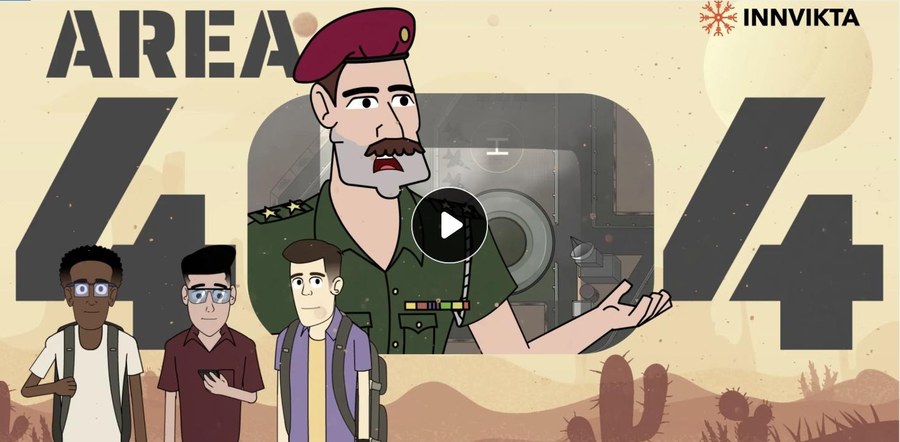 Watch the course review
Gamification & Simulation FAQs
What is the difference between gamification and game-based learning?
Gamification adds game elements (points, badges, leaderboards) to existing training. Game-based learning builds the entire learning experience as a game or simulation. We do both, from simple badge systems to full 3D simulated environments.
Does gamification actually improve learning outcomes?
Research consistently shows 20-40% improvement in engagement and retention when gamification is applied correctly. The key is aligning game mechanics with learning objectives, not just adding points for the sake of it. We design using Merrill's First Principles to ensure real behaviour change.
Can you add gamification to our existing eLearning courses?
Yes. We can retrofit gamification elements into existing SCORM/xAPI courses or redesign them from the ground up. Common additions include scenario branching, decision-based scoring, timed challenges, and achievement systems.
What industries benefit most from simulation-based training?
Simulations are especially effective in healthcare (clinical decision-making), banking (compliance scenarios), manufacturing (equipment operation), and sales (customer interaction practice).
How long does it take to develop a gamified course?
A gamified module typically takes 8-12 weeks depending on complexity. Simulations with 3D environments take longer than badge-based gamification layers. We scope everything during our free consultation.
Ready to Build Simulations That Transform Performance?
Let's talk about the scenarios that matter most. We'll design an experience that teaches through doing.
Start your simulation project →